Good Machine Learning Practice for Medical Device Development: MHRA, FDA and Health Canada Guiding Principles

The U.S. Food and Drug Administration (FDA), Health Canada, and the UK’s Medicines and Healthcare products Regulatory Agency (MHRA) have jointly identified 10 guiding principles for Good Machine Learning Practice (GMLP) in medical device development.
These principles aim to support the development of safe, effective, and high-quality medical devices that use artificial intelligence and machine learning (AI/ML). They address the unique challenges associated with data-driven development, model complexity, and the potential for performance changes during real-world use.
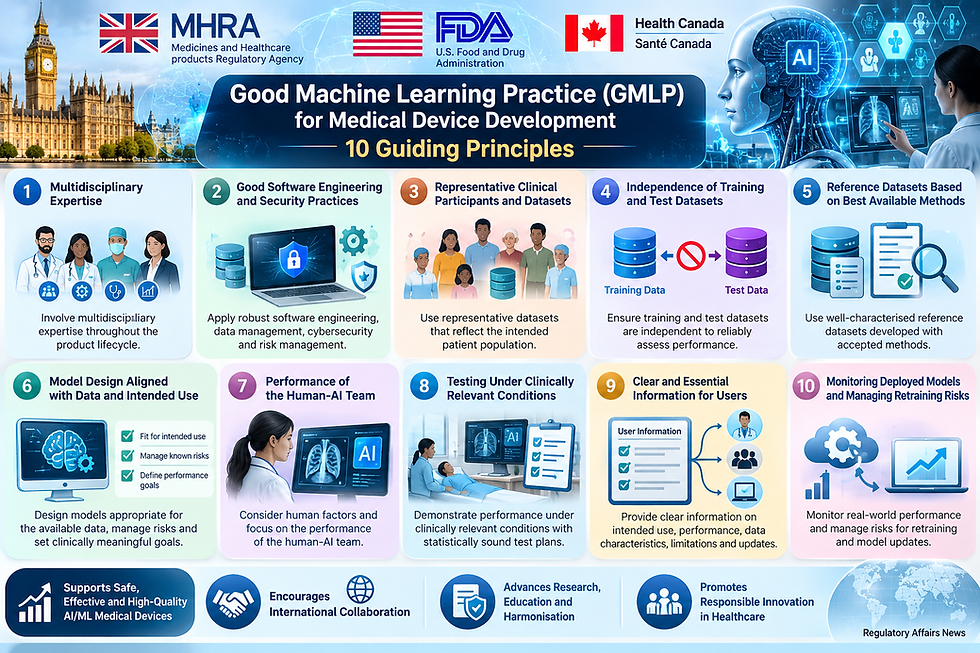
The guiding principles provide a foundation for developing good machine learning practices throughout the medical device lifecycle. They also identify opportunities for international collaboration on research, educational resources, harmonisation, and consensus standards.
1. Multidisciplinary Expertise Throughout the Product Lifecycle
Medical device development should involve multidisciplinary expertise throughout the total product lifecycle. Understanding the model’s intended integration into clinical workflows, its expected benefits, and associated patient risks helps ensure that the device addresses clinically meaningful needs and supports safe and effective use.
2. Good Software Engineering and Security Practices
Model development should incorporate good software engineering, data quality assurance, data management, and robust cybersecurity practices. Methodical risk management and design processes should document design decisions, implementation approaches, and the rationale behind risk management activities. Data authenticity and integrity should also be maintained.
3. Representative Clinical Study Participants and Datasets
Clinical study participants and datasets should adequately represent the intended patient population. Relevant characteristics, including age, gender, sex, race, and ethnicity, should be considered alongside intended use and measurement inputs.
Appropriate sample sizes and representative datasets help manage bias, assess usability, and evaluate whether model performance can be generalised across the intended population. They also help identify circumstances in which the model may underperform.
4. Independence of Training and Test Datasets
Training and test datasets should be appropriately independent. Potential sources of dependence, including patient-related factors, data acquisition methods, and study sites, should be considered and addressed. This helps support a reliable assessment of model performance using data independent of the training process.
5. Reference Datasets Based on the Best Available Methods
Reference datasets should be developed using accepted, best available methods to ensure that the data are clinically relevant and well characterised. Their limitations should be understood. Where available, accepted reference datasets should support the assessment of model robustness and generalisability across the intended patient population.
6. Model Design Aligned with Available Data and Intended Use
Model design should be appropriate for the available data and reflect the device’s intended use. Known risks, including overfitting, performance degradation, and security risks, should be actively addressed.
Clinical benefits and risks should inform clinically meaningful performance goals for testing. Considerations should include global and local performance, uncertainty and variability in inputs and outputs, intended patient populations, and clinical use conditions.
7. Performance of the Human-AI Team
For devices involving human interaction with AI, human factors and the interpretability of model outputs should be considered. The focus should be on the performance of the human-AI team rather than evaluating the model in isolation. This approach recognises the importance of how users interpret and apply model outputs within clinical workflows.
8. Testing Under Clinically Relevant Conditions
Testing should demonstrate device performance under clinically relevant conditions. Statistically sound test plans should generate relevant performance information independently of the training dataset.
Evaluations should consider the intended patient population, important subgroups, clinical environment, human-AI team performance, measurement inputs, and potential confounding factors.
9. Clear and Essential Information for Users
Users should have access to clear, relevant information appropriate to their intended audience, including healthcare professionals and patients. This information should cover:
Intended use and indications for use.
Model performance across relevant subgroups.
Characteristics of the training and test data.
Acceptable inputs and known limitations.
Interpretation of the user interface and integration into clinical workflows.
Users should also be informed about device modifications and updates arising from real-world performance monitoring. Where available, the basis for these decisions should be communicated, along with a means of reporting concerns to the developer.
10. Monitoring Deployed Models and Managing Retraining Risks
Deployed models should be capable of monitoring in real-world use to maintain or improve safety and performance.
For models that are periodically or continually trained after deployment, appropriate controls should address risks such as overfitting, unintended bias, and performance degradation caused by changes in datasets, including dataset drift. These risks should be managed to help maintain the safety and performance of the device during use by the human-AI team.
Importance of GMLP for Medical Device Development
The 10 guiding principles provide a framework for addressing the specific considerations associated with AI/ML-enabled medical devices. They cover multidisciplinary development, software engineering, cybersecurity, representative data, model design, clinical performance, human factors, transparency, and post-deployment monitoring.
The principles also highlight opportunities for collaboration among international regulatory bodies, standards organisations, and other stakeholders to advance research, education, harmonisation, and consensus standards.
As AI/ML technologies continue to evolve, good machine learning practices and supporting standards will also need to develop to address emerging challenges and support responsible innovation in healthcare.


Comments