TGA Med. Dev Guidance: Unique Device Identification (UDI) Compliance for Medical Devices in Australia

The Australian Therapeutic Goods Administration (TGA) has updated its guidance on the implementation of the Unique Device Identification (UDI) system for medical devices supplied in Australia. The guidance, Complying with the Unique Device Identification Timeframes for Medical Devices, Version 2.0, published in May 2026, explains the phased UDI compliance timelines, sponsor responsibilities, transitional arrangements, and direct marking obligations for medical devices and IVDs.
The Australian UDI system was introduced to improve medical device traceability, strengthen post-market surveillance activities, and support faster regulatory action during safety events and recalls. The guidance notes that challenges in tracking devices during previous medical device safety incidents highlighted the need for a more effective identification system.
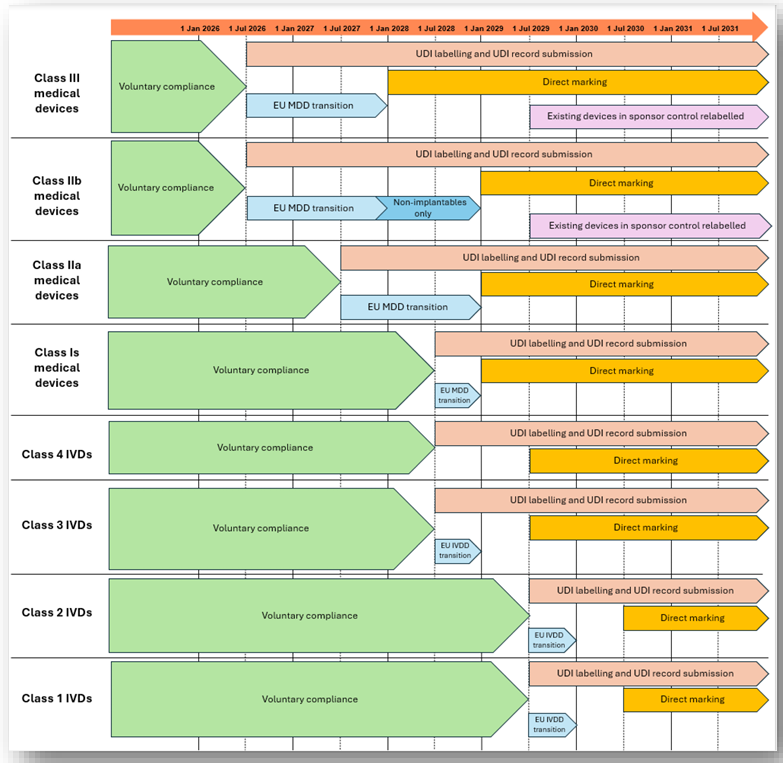
The guidance explains that Australia is implementing UDI requirements through a phased approach over five years, beginning with high-risk medical devices and later expanding to lower-risk device classes. The system supports improved device identification and regulatory oversight throughout the product lifecycle.
The document was developed to help sponsors and manufacturers understand:
UDI compliance timelines
UDI labelling requirements
UDI record submission obligations
Direct marking requirements
Transitional arrangements for existing devices
The guidance also provides examples and implementation scenarios to help organisations understand when UDI obligations apply.
UDI Compliance Phases
The TGA explains that UDI implementation consists of:
A voluntary compliance period
A mandatory compliance period
The voluntary compliance phase began on 24 March 2025 and allows sponsors and manufacturers time to prepare internal systems, update labels, validate data, and establish UDI submission processes. Mandatory compliance begins once a device reaches its official UDI compliance start date. All applicable devices must become fully compliant by 1 July 2030, unless exempt or granted Consent to Supply by the TGA.
UDI Compliance Requirements
The guidance explains that manufacturers must:
Assign a UDI-Device Identifier (UDI-DI)
Apply UDI-compliant labelling to devices and packaging
Meet applicable direct marking requirements
Sponsors are responsible for submitting UDI records into the Australian Unique Device Identification Database (AusUDID) and linking the data to the relevant ARTG inclusion.
The guidance states that UDI records should generally be submitted within 30 days of supplying the device in Australia.
Direct Marking Requirements
Direct marking applies mainly to reusable medical devices that are reprocessed between patient use. Manufacturers are required to permanently place the UDI on the device itself, while sponsors must update the associated UDI records in the AusUDID.
The guidance clarifies that direct marking does not apply to certain devices, such as single-use products and some implantable devices.
UDI Compliance Timelines
The guidance provides phased implementation timelines according to device classification.
For medical devices:
Class III and Class IIb devices must comply with UDI labelling and record submission requirements by 1 July 2026
Class IIa devices must comply by 1 July 2027
Class Is devices must comply by 1 July 2028
For IVD devices:
Class 4 and Class 3 IVDs must comply by 1 July 2028
Class 2 and Class 1 IVDs must comply by 1 July 2029
The guidance also outlines separate timelines for direct marking requirements depending on device type and risk class.
Transitional Arrangements for Existing Devices
The document includes transitional provisions for “existing devices,” which are devices manufactured and labelled before their applicable UDI compliance date.
The guidance explains that:
Existing Class III and Class IIb devices still under sponsor control must be relabelled by 1 July 2029
Other lower-risk devices and IVDs may remain exempt from relabelling requirements for the lifetime of the device
All existing devices remain exempt from direct marking requirements for their lifetime.
The guidance also clarifies the meaning of “sponsor control,” which includes devices stored in sponsor warehouses or returned to sponsors before redistribution.
EU MDR and IVDR Transitional Arrangements
The TGA guidance also addresses transitional arrangements for devices supplied in Australia under legacy EU MDD and IVDD certificates.
Certain devices benefiting from EU transitional extensions may receive extended Australian UDI compliance timelines. However, once a device fully transitions to EU MDR or IVDR compliance, the standard Australian UDI timelines immediately apply.
The guidance emphasises that organisations must still meet Australian UDI requirements even when devices are supplied under overseas regulatory certificates.
Consent to Supply and Compliance Expectations
If sponsors cannot meet UDI obligations by the required compliance date, they may apply for Consent to Supply from the TGA.
The guidance notes that these applications are reviewed on a case-by-case basis and are intended only for exceptional circumstances.
The document also warns that non-compliance may result in regulatory actions such as:
Suspension or cancellation from the ARTG
Civil penalties
Infringement notices
The guidance also references additional support tools and implementation resources available through the TGA UDI Hub. The guidance also highlights the growing global focus on harmonised device identification systems and regulatory transparency throughout the medical device lifecycle.



Comments