EMA Guidance: Qualification of Novel Methodologies for Medicinal Product Development

Innovation is transforming medicinal product development through the introduction of novel methodologies such as biomarkers, digital health technologies, artificial intelligence (AI), modelling and simulation, real-world data, patient registries, and advanced non-clinical testing methods. These approaches have the potential to improve evidence generation, streamline drug development, and support more informed regulatory decision-making. However, before they can be widely adopted in regulatory submissions, their scientific validity and intended use must be appropriately evaluated.
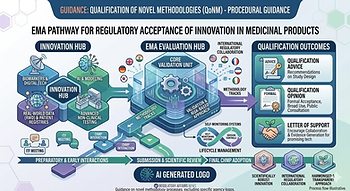
To facilitate the regulatory acceptance of these innovative approaches, the European Medicines Agency (EMA) has published the Qualification of Novel Methodologies (QoNM) for Medicinal Product Development – Procedural Guidance to Applicants. The guidance describes the qualification process, eligibility criteria, evidence expectations, lifecycle management, and regulatory procedures for obtaining Qualification Advice or a Qualification Opinion for novel methodologies intended to support medicinal product development and regulatory decision-making.
Scope and Eligibility
The guidance applies to innovative methodologies that support evidence generation for regulatory benefit-risk assessment throughout the medicinal product lifecycle, including pharmaceutical quality, non-clinical studies, clinical development, and post-authorisation activities.
Methodologies eligible for qualification should address unmet needs or provide advantages over existing approaches, have clearly defined Contexts of Use (CoU), and be broadly applicable across multiple medicinal product development programmes. Examples include biomarkers, clinical outcome measures, patient registries, real-world data sources, modelling and simulation approaches, AI and machine learning tools, digital health technologies, and novel non-clinical methodologies.
The guidance also clarifies that technologies or devices themselves, methodologies intended only for a single product development programme, and approaches that do not directly support regulatory evidence generation are generally outside the scope of the qualification programme.
Preparing a Qualification Request
The EMA encourages developers to engage early with the Agency before submitting a Qualification request. Early interactions may include Innovation Task Force (ITF) briefing meetings and informal discussions with the Scientific Advice Office to determine whether a proposed methodology is suitable for the Qualification programme.
These interactions help applicants clarify eligibility, refine the intended Context of Use, understand documentation requirements, and determine whether Qualification Advice or a Qualification Opinion is the most appropriate regulatory pathway. Early engagement is particularly beneficial for academic organisations, small and medium-sized enterprises (SMEs), biotechnology companies, and developers of highly innovative methodologies.
Qualification Procedure
The Qualification of Novel Methodologies procedure is managed by the EMA Scientific Advice Office and involves scientific assessment by a dedicated Qualification Team supported by the Scientific Advice Working Party (SAWP) and the Committee for Medicinal Products for Human Use (CHMP).
Applicants submit their requests through the EMA IRIS platform together with a comprehensive briefing package describing the methodology, available evidence, proposed Context of Use, and qualification objectives. The procedure includes scientific review, discussion meetings with applicants, assessment of supporting evidence, and preparation of either a Qualification Advice Letter or a Qualification Opinion.
Where sufficient evidence has not yet been generated, the EMA may provide Qualification Advice to guide future development or publish a Letter of Support for promising methodologies that require additional validation before qualification.
Qualification Advice, Qualification Opinion and Letters of Support
Depending on the maturity of the methodology and supporting evidence, applicants may receive one of several regulatory outcomes.
Qualification Advice provides confidential scientific recommendations on study design, evidence generation, and future development plans to support eventual qualification.
Qualification Opinions represent formal regulatory acceptance of a methodology within a specified Context of Use. Draft opinions undergo public consultation before final adoption by the CHMP, providing transparency and encouraging scientific discussion among stakeholders.
For innovative methodologies that show promise but require additional evidence, the EMA may publish a Letter of Support to encourage collaboration, further validation, and broader evidence generation before pursuing a future Qualification Opinion.
Evidence Generation and Context of Use
A key component of every qualification request is the definition of the methodology's Context of Use (CoU), which clearly describes how the methodology will be applied, the scientific question it addresses, and its intended role in medicinal product development.
Applicants are encouraged to develop structured qualification plans, generate evidence using predefined study designs, perform appropriate validation, and apply a risk-based approach when demonstrating scientific validity. The required level of evidence depends on the methodology's intended regulatory impact, with methodologies supporting major regulatory decisions requiring more robust validation than those used in exploratory research.
The guidance also highlights methodology-specific considerations for biomarkers, clinical outcome assessments, surrogate endpoints, digital health technologies, AI-based methodologies, modelling and simulation, real-world evidence, and novel non-clinical testing approaches.
Lifecycle Management
Qualification does not represent the end of regulatory oversight. The guidance emphasises the importance of lifecycle management to ensure that qualified methodologies remain scientifically valid as technologies, data sources, software, and clinical practice continue to evolve.
Developers should establish plans for ongoing validation, performance monitoring, version control, change management, and periodic review. Significant modifications to qualified methodologies or expansion into new Contexts of Use may require additional evidence and follow-up qualification procedures.
International Collaboration
Although the EMA administers the Qualification programme, the guidance recognises the importance of international regulatory collaboration. Subject to applicable confidentiality agreements, non-EU regulatory authorities may participate as observers during qualification discussions, helping to promote scientific alignment and greater consistency in the evaluation of innovative methodologies across global regulatory agencies.
Such collaboration supports international harmonisation while allowing each regulatory authority to maintain independent decision-making within its own jurisdiction.
By defining eligibility criteria, qualification procedures, evidence expectations, Context of Use requirements, and lifecycle management principles, the guidance promotes the responsible adoption of emerging technologies such as biomarkers, digital health technologies, artificial intelligence, modelling and simulation, and real-world evidence.
References
For complete details, refer to the guidance: Qualification of Novel Methodologies (QoNM) for Medicinal Product Development – Procedural Guidance to Applicants


Comments