USFDA Compliance Program: Preapproval Inspections (PAIs) for Drug Manufacturing Facilities

Before approving a New Drug Application (NDA) or Abbreviated New Drug Application (ANDA), the U.S. Food and Drug Administration (FDA) must ensure that the manufacturing facilities are capable of consistently producing medicines that meet Current Good Manufacturing Practice (CGMP) requirements.
Preapproval Inspections (PAIs) are conducted to evaluate manufacturing readiness, verify the accuracy of Chemistry, Manufacturing and Controls (CMC) information, and confirm that facilities can manufacture high-quality products.
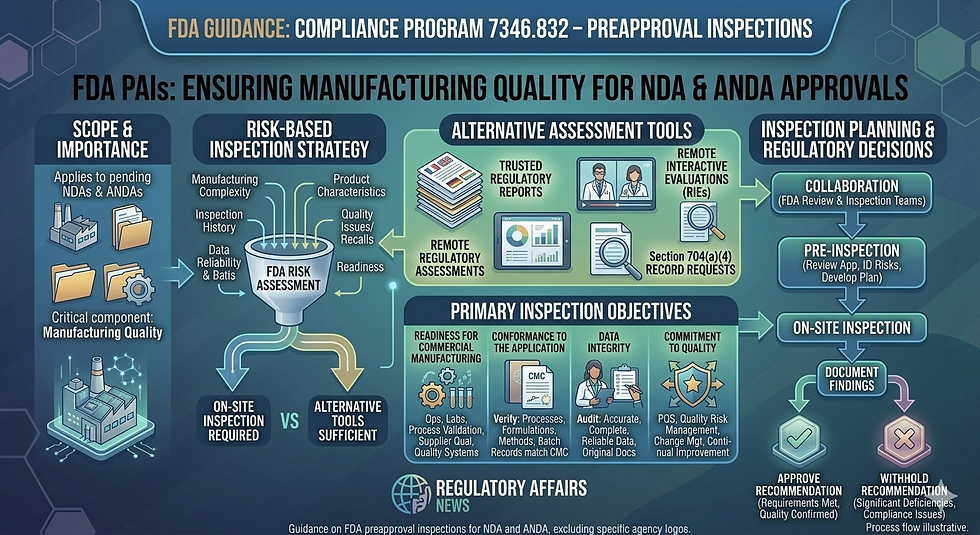
To support this process, the FDA published Compliance Program – Preapproval Inspections, which introduces a strengthened risk-based inspection strategy, greater use of alternative assessment tools, and improved coordination between FDA review and inspection teams to support timely regulatory decisions.
Why This Compliance Program Is Important
Manufacturing quality is a critical component of every marketing application. Even if a medicine demonstrates safety and efficacy, FDA approval depends on confidence that the manufacturing facility can consistently produce quality products. The revised compliance program adopts a science- and risk-based approach, allowing FDA to determine when a Preapproval Inspection is necessary and focus inspection resources on higher-risk facilities while maintaining efficient application reviews.
Scope of the Compliance Program
The guidance applies to manufacturing facilities referenced in pending NDAs and ANDAs. It helps FDA determine whether facilities comply with CGMP requirements, whether manufacturing processes match the submitted application, and whether commercial production can be performed consistently. Where necessary, inspection coverage may also be expanded to include additional CGMP inspections or other FDA compliance programs.
Risk-Based Inspection Strategy
Rather than inspecting every facility, FDA performs a risk assessment using information submitted in the application together with the facility's compliance history. Factors considered include manufacturing complexity, product characteristics, inspection history, quality issues, recalls, complaints, data reliability, and overall manufacturing readiness. Based on this assessment, FDA decides whether a Preapproval Inspection is required or whether alternative assessment tools provide sufficient information.
Alternative Assessment Tools
The compliance program expands FDA's use of alternative tools to support facility evaluations.
These include inspection reports from trusted international regulatory authorities, remote regulatory assessments, Remote Interactive Evaluations (RIEs), and requests for records under Section 704(a)(4) of the FD&C Act. These tools may supplement or, where appropriate, replace an on-site inspection.
Primary Inspection Objectives
Every Preapproval Inspection focuses on four key objectives.
Readiness for Commercial Manufacturing
FDA evaluates whether the facility is prepared for commercial manufacturing by assessing manufacturing operations, laboratory capabilities, process validation, supplier qualification, contamination controls, batch release procedures, and quality management systems.
Conformance to the Application
Inspectors verify that manufacturing processes, formulations, analytical methods, and batch records are consistent with the information submitted in the application's CMC section.
Data Integrity
FDA audits manufacturing and laboratory records to confirm that submitted data are accurate, complete, reliable, and supported by original documentation.
Commitment to Quality
The inspection also evaluates the manufacturer's Pharmaceutical Quality System (PQS), including quality risk management, change management, continual improvement, and overall commitment to maintaining product quality throughout the product lifecycle.
Inspection Planning and Regulatory Decisions
Inspection planning involves collaboration between FDA review and inspection teams. Before the inspection, FDA reviews the application, identifies quality risks, and develops an inspection plan focused on areas requiring verification. Following the inspection, findings are documented and used to support either an Approve Recommendation when manufacturing requirements are met or a Withhold Recommendation when significant quality or compliance deficiencies are identified.
By focusing on manufacturing readiness, application conformance, data integrity, and pharmaceutical quality systems while incorporating alternative assessment tools and coordinated regulatory review, the program helps ensure that only facilities capable of consistently manufacturing safe and high-quality medicines receive marketing approval.
References
For complete details, refer to the guidance FDA Compliance Program 7346.832 – Preapproval Inspections (June 2026)


Comments