FDA Updates on Biosimilar Development and Postapproval Manufacturing Changes

The US Food and Drug Administration (FDA) has published two important guidance documents addressing the development, approval and lifecycle management of biosimilar and interchangeable biosimilar products. The Questions and Answers on Biosimilar Development and the BPCI Act, Revision 4, and Postapproval Manufacturing Changes to Biosimilar and Interchangeable Biosimilar Products: Questions and Answers were issued in October 2026.
Together, these guidance documents provide recommendations for demonstrating biosimilarity, planning regulatory submissions, addressing product presentations and development requirements, and managing manufacturing changes after approval. They support a lifecycle-based approach to biosimilar development, with a focus on product quality, safety, effectiveness and regulatory compliance.
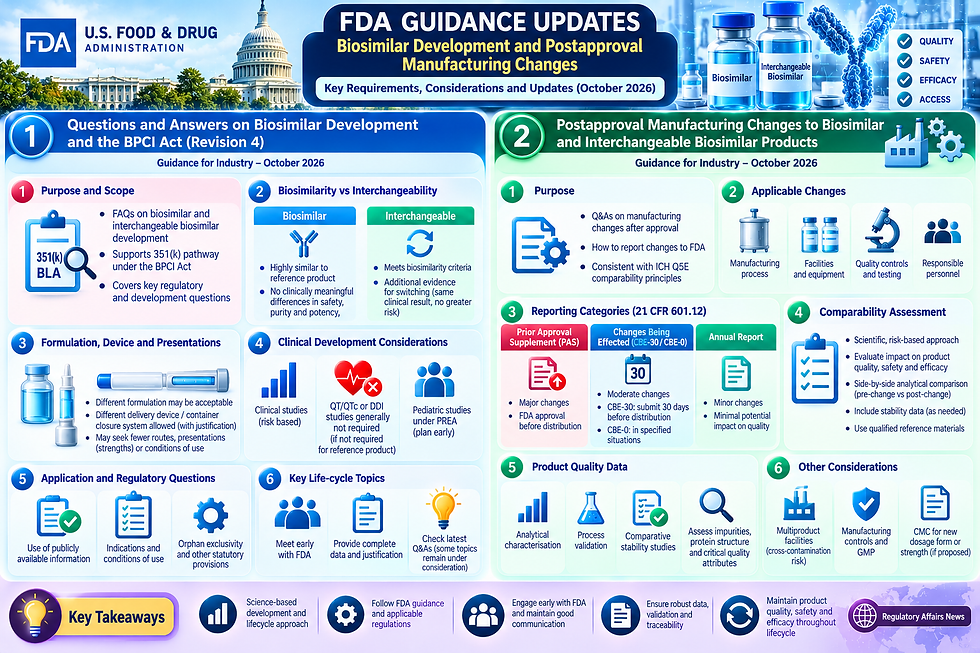
The guidance explains FDA’s interpretation of requirements under section 351(k) of the Public Health Service Act (PHS Act), established through the Biologics Price Competition and Innovation Act (BPCI Act). This pathway allows applicants to seek licensure of products shown to be biosimilar to, or interchangeable with, an FDA-licensed biological reference product.
Biosimilarity and Interchangeability
A biosimilar must be highly similar to its reference product, notwithstanding minor differences in clinically inactive components, and must have no clinically meaningful differences in safety, purity and potency. Interchangeability requires additional evidence that the product can be expected to produce the same clinical result as the reference product and, when a patient receives repeated administrations, that switching between the products does not introduce greater risk in terms of safety or diminished efficacy.
The guidance provides answers to common development questions and helps sponsors understand the information needed to support a 351(k) biologics license application (BLA).
Formulation, Delivery Devices and Product Presentations
A proposed biosimilar may have a different formulation from the reference product if it meets the applicable biosimilarity standard. Differences in delivery devices or container closure systems may also be acceptable, provided they do not create clinically meaningful differences or result in an unapproved route of administration, dosage form, strength or condition of use.
Where a different device or container closure system is proposed, applicants may need to provide compatibility, extractables and leachables, stability, performance and human factors data, as appropriate. Applicants may also seek licensure for fewer routes of administration, presentations or conditions of use than those approved for the reference product, subject to the applicable requirements.
Clinical Development and Pediatric Considerations
The guidance clarifies that certain studies, such as QT/QTc or drug–drug interaction studies, are generally not needed for a proposed biosimilar when they were not required for the reference product. However, FDA may impose relevant postmarketing requirements in appropriate circumstances when studies required for the reference product remain incomplete.
Pediatric assessment requirements under the Pediatric Research Equity Act (PREA) are also addressed. A non-interchangeable biosimilar is generally considered to have a new active ingredient for PREA purposes, unless the requirement is waived, deferred or inapplicable. FDA encourages sponsors to plan pediatric studies early and submit an initial pediatric study plan at the appropriate stage of development.
Application Scope, Indications and Exclusivity
The guidance addresses questions concerning the use of publicly available information about a reference product, applications seeking interchangeability, and requests for indications or conditions of use. It also discusses specific situations involving new routes of administration, dosage forms or strengths, as well as orphan exclusivity and other statutory provisions relevant to biological product applications.
Revision 4 consolidates finalised questions and answers and replaces the September 2021 Revision 2 guidance. FDA maintains a separate process for draft questions and answers that remain under consideration; sponsors should therefore check the status of individual questions before relying on them for development decisions.
The second guidance focuses on manufacturing changes made after a biosimilar or interchangeable biosimilar product has been licensed. It explains the information applicants should provide to support these changes and recommends an approach consistent with the principles of ICH Q5E, Comparability of Biotechnological/Biological Products Subject to Changes in Their Manufacturing Process.
Manufacturing Change Reporting Categories
Under 21 CFR 601.12, applicants must evaluate manufacturing changes and report them to FDA using the appropriate category. The category depends on the potential impact of the change on product identity, strength, quality, purity or potency as these characteristics relate to safety and effectiveness.
The guidance describes three main reporting pathways:
Prior Approval Supplement (PAS): Used for major changes with a substantial potential to adversely affect product quality. FDA approval is required before distributing product manufactured using the change.
Changes Being Effected (CBE-30 or CBE-0): Used for qualifying moderate changes. A CBE-30 supplement generally must be received at least 30 days before distribution; CBE-0 may be appropriate in specified circumstances.
Annual Report: Used to document minor changes that have minimal potential to adversely affect product quality.
Applicants should clearly identify the reporting category and, where a supplement is required, submit it as a chemistry, manufacturing and controls (CMC) supplement. The cover letter should list all changes included, and related labeling changes should be included where applicable.
Comparability Assessment and Product Quality Data
Applicants should assess product comparability before and after a manufacturing change. The extent of evidence should be proportionate to the nature of the change and its potential risks. The comparability exercise should include appropriate analytical methods and quality attributes, with sufficient data to demonstrate that the change has not adversely affected product quality, safety or efficacy.
Depending on the change, evaluation may be needed at multiple manufacturing stages, including intermediates, drug substance and drug product. Applicants should provide process validation information where applicable and consider comparative stability studies, particularly when changes may affect protein structure, purity, impurity profiles or product stability.
A side-by-side analytical comparison of an appropriate number of prechange and postchange lots is recommended, with stability data included as appropriate. Historical analytical data may support the assessment when scientifically justified. If analytical methods have changed since licensure, suitable assay bridging data should be provided.
Reference Materials and Manufacturing Controls
The guidance recommends including a well-qualified in-house reference material in the comparability exercise. This material provides a calibration point for evaluating whether the postchange product remains comparable to the prechange product.
For products introduced into multiproduct manufacturing areas or contract manufacturing facilities, applicants should evaluate the risks of cross-contamination and product mix-ups. Appropriate identity testing, manufacturing controls, personnel and material-flow controls, and other current good manufacturing practice measures should be implemented and described sufficiently for FDA evaluation.
The guidance also addresses CMC information for supplements proposing a dosage form or strength not previously licensed under the 351(k) BLA. Such submissions must meet the applicable statutory requirements, including demonstrating the required relationship to the reference product.
References


Comments