UK MHRA Guidance: Marketing Authorisation Variations and Renewals for Medicines

The UK Medicines and Healthcare products Regulatory Agency (MHRA) has published two guidance documents covering important aspects of medicines regulatory lifecycle management: variations to marketing authorisations and renewal of marketing authorisations.
The first explains how marketing authorisation holders can submit changes to authorised medicines, including minor variations, major variations, and extensions. The second outlines renewal requirements for products authorised through different regulatory routes, including standard renewals, conditional marketing authorisations, and the International Recognition Procedure (IRP).
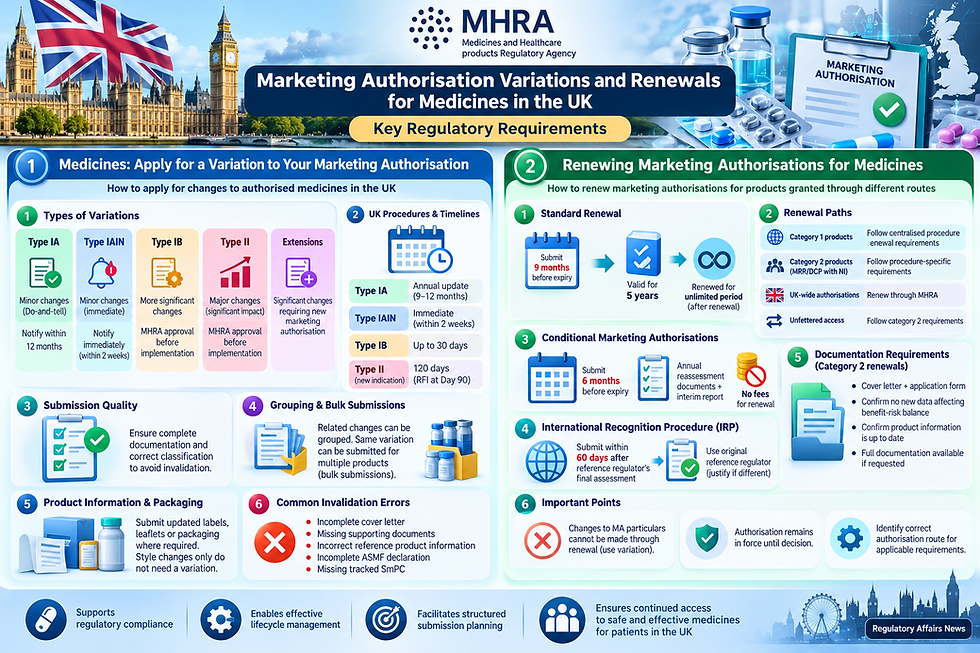
This guidance explains how marketing authorisation holders can apply for changes to authorised medicines. The procedure depends on the nature and significance of the proposed change and its potential impact on product quality, safety, and efficacy.
Types of Marketing Authorisation Variations
Type IA: Minor changes with little or no impact on quality, safety, or efficacy. Most follow a “do-and-tell” procedure, with notification generally within 12 months. Type IAIN changes require immediate notification.
Type IB: Minor changes that do not qualify as Type IA, Type II, or an extension. MHRA approval is required before implementation.
Type II: Major changes that may significantly affect quality, safety, or efficacy. Approval is required before implementation.
Extensions: Significant changes requiring a new marketing authorisation application, including certain changes to active substances, strengths, pharmaceutical forms, or routes of administration.
UK Variation Procedures and Notifications
The applicable procedure depends on the marketing authorisation type and the proposed change. The updated variation guidance and categories apply from 15 January 2026.
Type IA variations that do not require immediate notification are generally included in annual updates. The submission window is normally between nine and 12 months after the oldest implementation date, subject to applicable exceptions. Type IAIN variations must be notified immediately after implementation; the MHRA considers two weeks a reasonable period.
Type IB and Type II Assessment Timelines
Type IB applications may take up to 30 days to process once all necessary documents have been received. If a Notification with Grounds letter is issued, applicants have one opportunity to address the identified deficiencies within the permitted response period.
Type II variations include major changes such as adding a new therapeutic indication. These applications follow a 120-day procedure. At Day 90, the MHRA issues either an approval decision or a Request for Further Information (RFI). The MHRA issues only one RFI, with one opportunity to respond.
Submission Quality and Grouping Changes
Applicants should ensure that submissions contain complete documentation and the correct variation classification. Common invalidation errors include incomplete cover letters, missing supporting documents, incorrect reference product information, incomplete Active Substance Master File declarations, and missing tracked Summary of Product Characteristics documents.
Related changes may be grouped when permitted. The highest-classified variation generally determines the procedure type, assessment timeline, and applicable fee. The same Type IB or Type II variation, or group of changes, may also be submitted as a bulk application for multiple marketing authorisations held by the same marketing authorisation holder. Applicants should obtain MHRA agreement where a proposed grouping is not covered by published examples.
Product Information, Packaging and Extensions
Where a variation affects product labelling, the patient information leaflet, or packaging, updated documents must be included where required. Changes limited to presentation style without changing the product do not require a variation. More significant changes that require a new marketing authorisation should follow the applicable extension procedure.
Overall, the guidance supports appropriate classification, complete submissions, and compliance with UK procedures for changes to authorised medicines.
This guidance explains how to renew marketing authorisations for medicines granted through different regulatory routes. It covers standard five-year renewals, annual renewals of conditional marketing authorisations, and renewals through the International Recognition Procedure.
Renewal of a Marketing Authorisation
A standard marketing authorisation is valid for five years from the date of authorisation. Renewal applications should generally be submitted nine months before expiry, except where the International Recognition Procedure applies.
After submission, the authorisation remains in force until the marketing authorisation holder is informed of the decision. Following renewal, the authorisation may be renewed for an unlimited period. However, where pharmacovigilance grounds require it, the authorisation may be renewed for a further five-year period, followed by one additional renewal application.
Renewal Requirements and Documentation
Requirements depend on the product category and authorisation route. Category 1 products should follow the applicable EU centralised procedure renewal requirements, including when renewal is submitted through the International Recognition Procedure.
Category 2 products authorised through mutual recognition or decentralised procedures involving Northern Ireland should follow the relevant procedure-specific requirements. Standalone national UK-wide authorisations should also be renewed through the MHRA using the applicable requirements.
For relevant category 2 renewals, a consolidated dossier is not generally expected. The submission may be limited to a cover letter and application form without annexes, as described in the guidance.
The cover letter should confirm that no new data are available that would change the benefit-risk balance. It should also confirm that product information remains up to date with current scientific knowledge or include a commitment to update it through the appropriate variation within three months after finalisation of the renewal.
Applicants must declare that full documentation is available if requested. Changes to marketing authorisation particulars cannot be made through standard renewal and must be submitted as variations.
Annual Renewal of Conditional Marketing Authorisations
Conditional marketing authorisations have separate renewal requirements. Except for applications submitted through the International Recognition Procedure, renewal applications should generally be submitted six months before expiry.
The application should include a cover letter, the required annual reassessment documents, and an interim report on fulfilment of the authorisation's obligations. The guidance states that there are no fees for renewal of a conditional marketing authorisation.
International Recognition Procedure for Renewals
The International Recognition Procedure can be used for standard renewals and annual renewals of conditional marketing authorisations.
Applicants should submit the renewal application to the MHRA as soon as possible after the reference regulator's final assessment becomes available, and no later than 60 days afterwards.
If the reference regulator recommends that the benefit-risk balance is no longer favourable, the MHRA must be notified without delay. The original reference regulator is expected to be used for renewal applications; a proposal to use a different reference regulator should be justified.
Renewals Through Unfettered Access
Marketing authorisation holders with products authorised through the unfettered access route should follow the renewal guidance applicable to category 2 products. Identifying the correct authorisation route helps ensure that the appropriate requirements are followed.


Comments