USFDA Guidance: Container Closure Systems for Human Drugs and Biological Products

As pharmaceutical products become more complex, the container closure system (CCS) plays an increasingly important role in maintaining the safety, quality, stability, and performance of a drug product. Packaging is not simply a means of containing a medicine—it can directly influence product quality through interactions between the drug, packaging materials, manufacturing processes, and storage conditions.
The U.S. Food and Drug Administration (FDA) has issued the draft guidance Container Closure Systems for Human Drugs and Biological Products to provide a risk-based framework for evaluating the quality of container closure systems used for human drugs, biological products, and certain combination products. The guidance covers packaging material safety, protection, performance, quality control, stability, and information to be included in regulatory submissions.
This August 2026 draft guidance is marked “Draft — Not for Implementation” and, when finalized, is intended to supersede FDA's 1999 container closure guidance and the related 2002 Questions and Answers document.
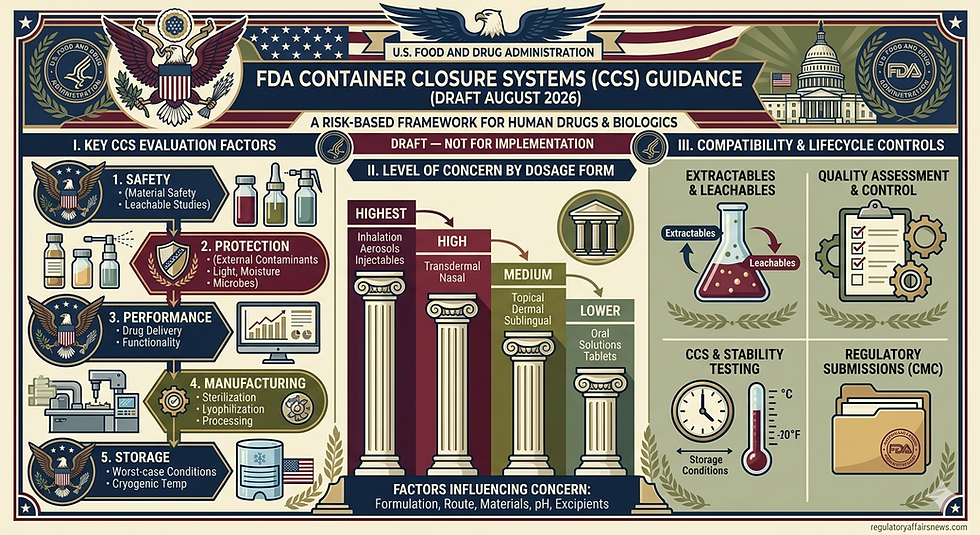
What Is a Container Closure System?
A container closure system is the collection of packaging components that together contain and protect a drug. It includes primary packaging components and may also include secondary packaging components when they provide additional protection.
A suitable CCS should protect the drug during storage and use without adversely affecting its safety, identity, strength, quality, or purity. Packaging materials should also be appropriately selected to minimize the potential for harmful or undesirable substances to enter the drug.
Modern CCSs may also perform additional functions, such as helping prepare the final dosage form or delivering the drug to the patient. In these situations, additional controls and testing may be necessary to demonstrate that the CCS performs its intended function without negatively affecting product quality.
A Risk-Based Approach to CCS Evaluation
FDA emphasizes that a container closure system suitable for one drug product cannot automatically be assumed to be suitable for another product.
The assessment should consider the specific drug formulation, materials of construction, CCS design, manufacturing processes, clinical use, route of administration, and storage and handling conditions.
Potential interactions between the drug and packaging materials can result in leachables, degradation of the active ingredient, changes in impurity profiles, particulate formation, altered stability, or changes in the properties of biological products.
The guidance therefore recommends identifying and characterizing CCS-related risks and implementing appropriate qualification, testing, and quality controls to address those risks.
Key Factors for Evaluating a CCS
FDA identifies several important factors that should be considered as part of the risk-based evaluation.
Safety of packaging materials is important because packaging components should not release harmful or undesirable substances that could expose patients.
Protection is necessary to protect the product from external contaminants, light, moisture, reactive gases, physical stress, microbial contamination, and leakage.
Performance evaluates whether the CCS performs the function for which it was designed. This becomes particularly important when the CCS also contributes to drug delivery.
Manufacturing processes such as washing, coating, sterilization, depyrogenation, and lyophilization may affect the suitability or performance of packaging components.
Storage and handling conditions should also be considered, including worst-case conditions such as very low or cryogenic temperatures.
Packaging Risks Vary by Dosage Form
The level of concern associated with a CCS depends on both the route of administration and the likelihood of interaction between the packaging components and the drug product.
Level of Concern | Examples |
Highest | Inhalation aerosols, injectable solutions and suspensions, inhalation solutions and suspensions, inhalation powders, powders for injection |
High | Transdermal products and delivery systems, nasal aerosols, ophthalmic products, nasal sprays, otic products |
Medium | Topical dermal products, lingual and buccal sprays, buccal/sublingual tablets, topical powders |
Lower | Oral solutions and suspensions, oral tablets and capsules, oral powders |
The guidance emphasizes that these categories are examples and should not replace a product-specific risk assessment. Factors such as formulation composition, CCS material and design, drug substance and excipients, pH, cosolvents, surfactants, preservatives, stabilizers, and other product characteristics can influence the level of concern.
Extractables and Leachables
Extractables and leachables are important considerations in the evaluation of packaging compatibility and safety.
Extractables are chemical entities that can be released from packaging materials under laboratory extraction conditions.
Leachables are chemical entities that enter the drug product from packaging materials under normal storage and use conditions or during stability studies.
The potential for leachables can vary depending on the packaging material, formulation, route of administration, storage conditions, and interactions between the CCS and drug product.
FDA recommends that appropriate assessments be performed and that leachables be identified and quantified using validated analytical methods when applicable.
Quality Assessment and Control
The draft guidance recommends that CCS quality assessments and controls be selected based on identified risks and appropriate mitigation strategies. For packaging components received by manufacturers, appropriate tests and acceptance criteria should be established to ensure consistency and quality.
CCS and Stability Testing
The drug product should be evaluated in the CCS proposed for marketing, including appropriate secondary packaging. The stability program should consider whether the CCS continues to maintain its intended protection and functionality throughout the product's shelf life.
For sterile products, container closure integrity testing is an important part of the assessment. The guidance also recommends considering additional testing such as shipping stress, freeze-thaw cycles, and thermal cycling when appropriate.
CCS Information in Regulatory Submissions
Container closure information forms an important part of the CMC documentation supporting regulatory submissions. For marketing applications, information may include the identity and specifications of the materials of construction, the selection of packaging materials, protection, compatibility, safety, extractables and leachables assessments, and container closure integrity for sterile products.
The guidance also addresses CCS information associated with investigational applications and master files.
This means that CCS considerations should be incorporated into pharmaceutical development and CMC strategy rather than being treated only as a packaging activity late in the regulatory submission process.
Postapproval Changes to Container Closure Systems
Changes to a CCS should be evaluated using a risk-based approach to determine their potential impact on the drug's identity, strength, quality, purity, or potency.
A packaging component change may require revised specifications and additional quality-related evaluations. The type of information submitted to FDA should depend on the potential for the change to adversely affect product safety or effectiveness.
Where recommended testing is not performed, the submission should provide appropriate scientific justification.
By applying a product-specific, risk-based approach to container closure systems, manufacturers can better control packaging-related risks, support product stability and quality, and provide appropriate CMC information throughout the pharmaceutical product lifecycle.
References
Guidance for Industry: Container Closure Systems for Human Drugs and Biological Products — U.S. Food and Drug Administration, Draft Guidance, August 2026.


Comments